

Pula is one of those rare places where you can sip a morning coffee in the shadow of a 2,000-year-old amphitheatre and swim in the Adriatic by lunchtime. The city packs a remarkable amount of history and coastline into a small area, which makes it an ideal day trip from anywhere in Istria.
Pula and its history
Pula is the largest city in Istria, home to roughly 52,000 people. The original hillfort was founded by the Histri, an Illyrian tribe, around the 10th century BC. Rome took control in 177 BC and renamed the city Pietas Julia, turning it into a vital port.
After Rome fell, the city passed through Byzantine, Venetian (1331–1797), Habsburg, Italian, and Yugoslav rule before becoming part of modern Croatia in 1991.
Every one of those historic periods left its mark on the city, and that is what makes the Pula sights so special.
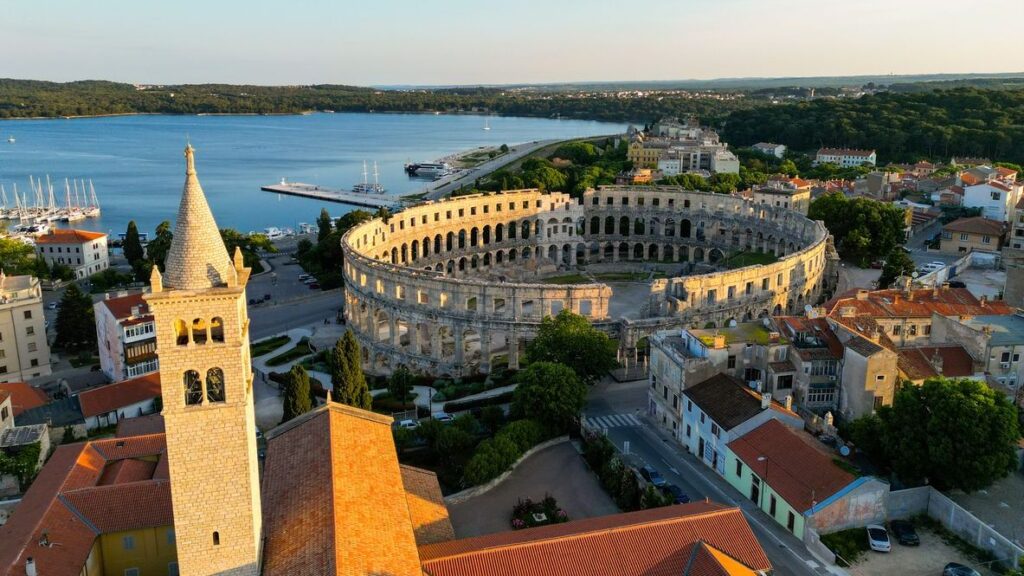
Explore the Pula Arena and Roman amphitheatre
Emperors Augustus and Vespasian built the Arena between 27 BC and AD 68 (Vespasian also initiated the construction of the Colosseum in Rome). It is the sixth-largest surviving Roman amphitheatre on earth and the only one with all four original side towers still standing.
Today, the Arena hosts the Pula Film Festival every July, plus opera, ballet, and major concerts.
The highlights of Pula Old Town
The Pula Old Town wraps around the base of a central hill crowned by the Kaštel fortress. It is small enough to cover on foot in a single morning, and the centre is pedestrianised.
The main area is Sergijevaca, a shopping street that takes you from the Arch of the Sergii straight to the Forum square.
The Forum is the social heart of the Pula Old Town and has been since Roman times. We suggest grabbing a table at one of the cafés and enjoying a glass of wine.
Must see Roman sights and ancient monuments
Beyond the Arena, the city also features several other well-preserved Roman remains. In particular, the Temple of Augustus, built between 2 BC and AD 14 during the emperor’s lifetime, stands on the Forum and is considered one of the finest surviving Roman temples outside Italy.
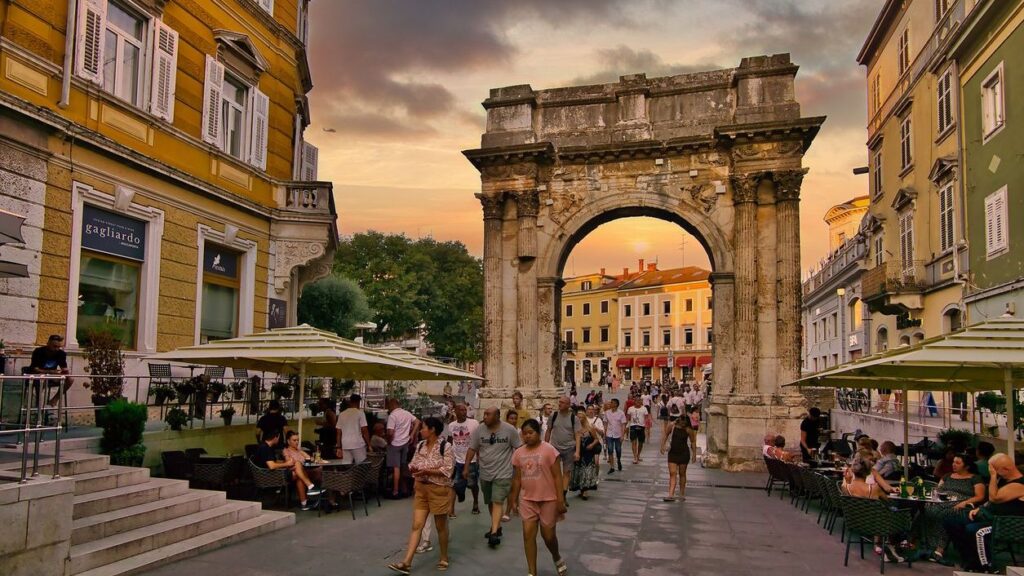
Meanwhile, a short walk away, the Arch of the Sergii (locally known as Zlatna Vrata, or the Golden Gate) was erected around 29–27 BC by the powerful Sergii family and still serves as an entrance to the pedestrian core.
Roman monument checklist
Pula Arena, the unmissable amphitheatre. In addition, the Temple of Augustus sits in the Forum square and can be admired from the exterior for free.
Meanwhile, the Arch of the Sergii serves as both a triumphal arch and a historic city gate.
Nearby, the Twin Gates (Porta Gemina) offer a striking example of a 2nd-century AD double archway. Similarly, Hercules Gate stands out as the oldest Roman monument in the city, dating back to the mid-1st century BC.
A little further on, the mosaic “Punishment of Dirce” is a beautifully preserved 3rd-century AD floor artwork tucked behind a residential block. The Cathedral of the Assumption rises on early Christian foundations that go back to the 4th century.
Finally, the Small Roman Theatre can be freely explored just below the Kaštel.
The best things to do and see in Pula
- Brijuni National Park: a 14-island archipelago, former summer residence of Yugoslav president Tito, reached by ferry from Fažana
- Cape Kamenjak: a wild nature reserve at Istria’s southern tip with hidden coves and clifftop swimming
- Verudela peninsula: Pula’s main beach area, including the popular Hawaiian Beach (Havajska plaža)
- Pula Aquarium: set inside the 19th-century Verudela Fort
- Lighting Giants: the shipyard cranes lit in changing colours after dark
- Pula Market: the cast-iron market hall from 1903, good for Istrian cheese, prosciutto and truffles
Nearby towns worth pairing with your Pula trip
The great thing about Istria is how close so many beautiful towns are. Pula makes a brilliant base for a day; however, the surrounding towns each have their own character and are ideal for a longer stay on the peninsula.
Poreč
About 58 km north, home to the 6th-century Euphrasian Basilica (a UNESCO World Heritage Site) and a relaxed harbour-front Old Town. Ideal as a base for exploring the whole peninsula.
Rovinj
Roughly 37 km up the coast, often called the most photogenic town in Croatia. Pastel houses tumble down to the sea around the Church of St Euphemia on the hilltop.
Motovun
The iconic hilltop town in central Istria is surrounded by truffle forests and home to a popular international film festival each summer.
Practical tips for your visit to Istria
If you are based in Poreč, Pula is roughly 58 km south down the Istrian peninsula. The drive takes about 55 minutes via the A9 motorway (the “Istrian Y”), with a small toll for cars.
| Season | Pros | Cons |
|---|---|---|
| May–June | Mild weather, manageable crowds, sea warming up | Some beach facilities still opening |
| July–August | Pula Film Festival, full events calendar, warmest sea | Hottest temperatures, busiest queues |
| September | Wine and olive harvest, warm sea, fewer crowds | Shorter daylight by late month |
| October–April | Quiet streets, cheaper accommodation | Some restaurants and ferries reduce hours |
What to bring
- Comfortable shoes, the Old Town is paved with smooth, slippery flagstones
- A refillable water bottle (public fountains are safe to drink from)
- Sun hat and reef-safe sunscreen for beach days
- A light layer for the Zerostrasse tunnels, even in summer
- Cash in euros for small market stalls (cards are widely accepted elsewhere)
- A swim bag if you plan to combine sightseeing with a dip at Verudela
Plan your trip to Pula today
Few cities in Europe trace 3,000 years of history within a thirty-minute walk, and even fewer pair that with proper Mediterranean swimming weather. Whether you come for the Arena, the quiet corners of the Pula Old Town, or simply a long lunch on the Forum, the Pula sights are perfect for both a quick day trip and a slower multi-day stay.
Ready to make the most of Istria?
Book your stay with Solis Poreč to explore the whole peninsula at your own pace. From comfortable rooms only a short walk from Poreč’s UNESCO-listed Euphrasian Basilica to easy connections south to Pula and the Brijuni islands, we make Istria simple.
Don’t waste more time, start planning your Croatian holiday today, and enjoy the sights of Pula and other Istrian towns nearby.